
Beyond Mnemonics:
Minding the Gap
By Dr. Mom
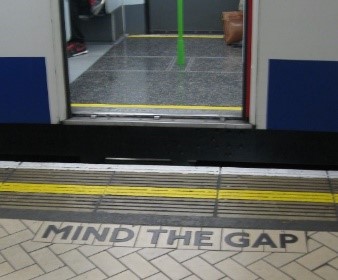
When traveling in Europe, among other places, you will likely encounter signs warning you to “mind the gap.” This simply means that you would do well to pay attention to where you are about to step because the surface on which you are perambulating will cease to exist momentarily—potentially at your peril. Knowing in advance about a gap allows you to adjust your gait, step resolutely, then seamlessly continue your journey.
When heeded, the instruction to mind the gap can mean the difference between admiring the Tower Bridge in London on two fully functioning legs or spending your afternoon in a hospital being treated for a sprained ankle (or worse).
Why bring up minding the gap on the “Vocabulary Mnemonics” page? The mission of our podcast is to help all of us learn the meanings of less-familiar vocabulary words to the point where we feel comfortable using those words in everyday life. The aforementioned “gap” in this context can be thought of as the space in time between our initial learning of a word’s meaning and the future occasion when we attempt to actually employ it in conversation.
As we all intuitively know from lived experience, not everything we are exposed to gets filed away in our brains such that we can easily access it on demand. Thankfully, we can greatly influence the strength of our memories by engaging with the words through practice. Practice is time sensitive, however. It’s best to begin practicing immediately after learning occurs because that is a precarious time for newly formed memories. Any learning we hope to retain long term must not be left to wallow in a time gap unattended.
Below are some concrete, educationally sound suggestions for what your vocabulary “practice” might look like:
- Repetition. Repeatedly expose yourself to each new word. Flashcards are great for this initial stage of coming to “own” them. Write the word on one side of a card, and the meaning and mnemonic on the other. Then, at least once a day, practice retrieving the words and associated info from memory—while riding in the car, waiting in line at the grocery store, sitting in the doctor’s office waiting room, anywhere. Don’t flip the card over to see your “answer” too quickly upon being stumped. Give your brain a moment to “go looking.” As you quiz yourself in this manner, you will be utilizing the testing effect, a long-established, highly effective principle of learning. (Watch for this effect to be discussed in more depth in an upcoming article).
- Relisten. Listen to the podcast again, but even more intentionally. For example, when you hear the featured vocabulary, pause the audio and try spelling it and saying its meaning. Then resume listening and see how you did. The more you actively attend to and engage with the word, the better.
- Create. Improve on the mnemonics Matt & I share by creating your own. Be guided by the characteristics of a good mnemonics we talk about in our Primacy-Recency Effect article, if you’d like, and individualize to your own life and experiences. Making a personal connection to the mnemonics greatly improves the likelihood that they will be effective for you.
- Investigate. Learn more about a given word by looking up the etymology, seeing more example sentences, and reviewing usages of the word from both current and historical publications. One example of this that was enlightening to me happened when I was learning more about the word “obsequious” (Episode 19). I saw that this very cool word was used in one of my favorite books, The Secret Garden, by Frances Hodgson Burnett. In 1911 the lead character in the story, Mary, described the servants she was accustomed to dealing with in India, “They were obsequious and servile and did not presume to talk to their masters as if they were their equals.” Seeing this reference gave me yet another “hook” on which to hang my memory of the meaning of obsequious.
- Explain. Tell somebody else about the word. Verbalizing your knowledge requires a deeper understanding, and you’ll discover if and precisely how your current level of learning falls short. You’ll experience what teachers constantly experience while teaching. Incomplete knowledge becomes immediately obvious to the teacher and, quite often, to the students, as well. It’s very enlightening, and super humbling.
- Attempt. Finally, use the word! It’s always scary at first, but consciously look for opportunities to let the new word come out of your mouth into the ears of others. It’s a fantastic feeling!
This list of practice strategies is not exhaustive, of course, but hopefully it gives you some ideas as to where to start. The bottom line is, be sure to mind the gap that occurs immediately after learning so you lose as little new knowledge as possible on your way to increasing your vocabulary permanently.
Good luck, and happy practicing!
 Vocabulary Mnemonics